The Golden Chain of Karma
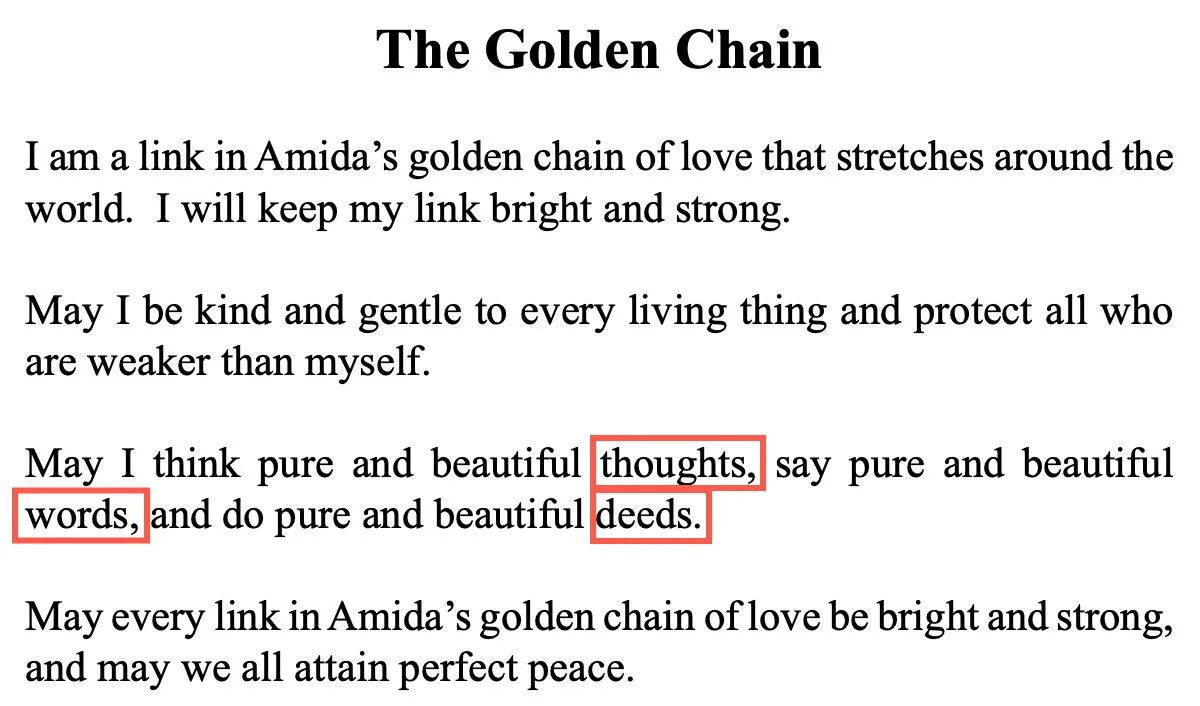
The Golden Chain, shown above, can be found on page 8 in our Service Book. At first glance, it appears to focus on the interdependence of all life, but the third stanza stands out as something altogether different. This is because it touches on the topic of karma—karma as the circumstances that we create for our lives.
This is done in three ways. First, our thoughts create mental habits. For example, if we think beautiful thoughts, then these types of thoughts become easier to create and sustain. Second, the words we use influences how we interact with others. It is both what we say, and how we say it. Third, our deeds live on long after they have been committed. How we behave can either create closeness or distance between ourselves and others.
In other words, we create our karma through our minds, our speech, and our deeds. Every time we behave in a certain way, it becomes easier to do it again. This is called habitual behavior, and in Buddhism it is described as karmic seeds that settle in our minds and affect how we think, speak, and behave moving forward. This is how habits are formed in Buddhism—both good and bad. It is a slippery slope in both directions.
It is actually very easy to create habits. It only requires sustained, repetitive behavior. For both good and bad habits, the mechanism is the same: repetition. This process is known as Neuroplasticity. We create new neural pathways in our minds as we repeat behaviors, and each time it becomes easier to travel down those same pathways. Luckily, this is simply how the brain works. It requires no willpower or special training.

Here are some Neuroplasticity “tricks” we can take advantage of:
1. We can hold only one thought in our minds at a time
2. We assign meaning to the events in our lives
3. The same event exists in consciousness
4. The mind follows the body
The first trick is what we would call focus. When at work, it is not that we are overwhelmed by too many thoughts at one time; rather, single thoughts are constantly being swapped in and out. All we need to do is practice keeping our attention on one thought for longer periods of time.
The second trick is very helpful and can lead to profound insight. It is not the events in our lives that cause our suffering, but rather how we value and interpret these experiences. As the saying goes, it is all in the eyes of the beholder—quite literally. This is where mindfulness training comes in.
Thirdly, the experiences in our minds are the same whether we are with someone we know, see a picture of someone we know, or say the name of someone we know. The brain experiences each in the same way. This is why being with a Buddha, seeing an image of a Buddha, or saying the name of a Buddha all have the same effect on us. This is why Namo Amida Butsu can have such a profound impact. We say it, we hear it, and we feel it—all as we bow.
The fourth trick is my favorite. In most religious traditions, the body follows the mind. Our behavior changes based on what we believe, so we are given more rules and clearer moral codes. But in Buddhism, it is the mind—and the karma we have created for ourselves—that causes us to suffer. In other words, if the mind is the problem, then trying to fix it solely through new beliefs is addressing the wrong end of the issue. As in the movie A Beautiful Mind, when John Nash is told, “You cannot think your way out of this.”
In the Buddhist tradition, we are given practices and processes that help us effortlessly create new habits. We all know how easy it is to create bad habits, and this same mechanism is simply waiting to be used in the service of creating good ones. For example, we learn to focus on our breathing to become more mindful; we chant one character at a time to cultivate single-mindedness; and we hold a shared pitch and tempo to experience oneness with others. No heroic actions are needed, and no special qualities are required. We simply and effortlessly create new habits that help us generate good karma whenever we think, speak, and act. How lucky we all are.
As John Lennon would say, this is “Instant Karma.”
Namo Amida Butsu, Rev. Jon Turner
