“I Can’t Do This Alone”: Shinran’s Religious Awakening
Shinran’s Kyōgyōshinshō is a masterpiece of Buddhist thought, written in a highly logical and systematic style. It draws extensively on Buddhist scriptures and the commentaries of earlier masters from India, China, and Japan. Yet, every so often, something remarkable happens: Shinran’s scholarly voice gives way to the voice of a deeply moved human being.
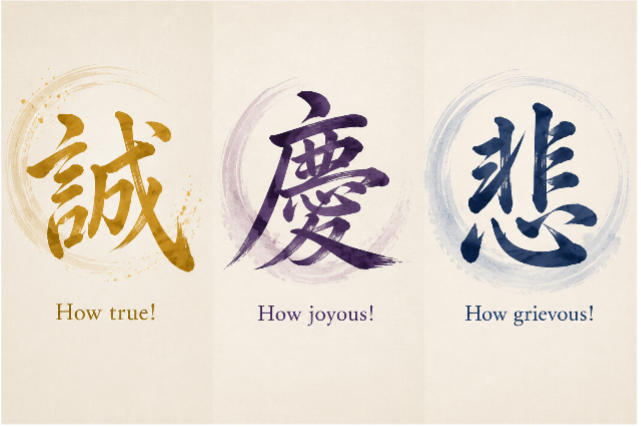
In several places, Shinran ends his words with kana (哉) - an expression that conveys a spontaneous emotional response, something like “How true!”, “How joyous!”, or “How grievous!” These expressions reveal something important about Shinran’s religious awakening. His realization of the Dharma was not merely an intellectual understanding. It moved his entire being.
Three of these expressions are particularly striking:
「誠なるかな」(makotonaru kana) — “How true!”
「慶ばしいかな」(yorokobashii kana) — “How joyous!”
「悲しいかな」(kanashiki kana) — “How grievous!”
“How True!” and “How Joyous!”
At the beginning of the Kyōgyōshinshō, Shinran encounters what he understands as the truth of the Primal Vow. His response is not detached or merely academic:
“Wholly sincere, indeed, are the words of truth that one is grasped, never to be abandoned, the right dharma all-surpassing and wondrous! Hear and reflect, and let there be no wavering or apprehension.” [CWS I, p. 4]
Here, Shinran is not simply explaining a Buddhist doctrine. He is responding to something that has touched his life.
Immediately afterward, he expresses his joy:
“How joyous I am, Gutoku Shinran, disciple of Sakyamuni!”
He goes on to describe the extraordinary fortune of encountering the Buddhist scriptures and commentaries and of hearing the teaching, practice, and realization of the Pure Land way. He concludes:
“Here I rejoice in what I have heard and extol what I have attained.”
“How Grievous!”
But Shinran’s religious awakening does not mean that he suddenly becomes a perfect or enlightened person. In fact, the deeper he encounters the Dharma, the more clearly he sees his own limitations.
Later in the Kyōgyōshinshō, he turns his attention from the immeasurable compassion of the Buddha to his own condition:
“I know truly how grievous it is that I, Gutoku Shinran, am sinking in an immense ocean of desires and attachments and am lost in vast mountains of fame and advantage, so that I rejoice not at all at entering the stage of the truly settled, and feel no happiness at coming nearer the realization of true enlightenment. How ugly it is! How wretched!” [CWS I, p. 125]
This may sound like a very different Shinran from the one who exclaimed, “How joyous!” But these two feelings are not contradictory. In Shinran’s religious experience, joy and sorrow exist together. The more deeply he encounters the Dharma, the more honestly he sees himself. He recognizes his desires, attachments, self-centeredness, and inability to free himself through his own efforts.
“I can’t do this alone.” - From Sorrow to Compassion
Yet Shinran’s awareness of his limitations does not end in despair. Instead, his limitations deepen his appreciation of Amida’s compassion. Near the conclusion of the Kyōgyōshinshō, he writes:
“How joyous I am, my heart and mind being rooted in the Buddha-ground of the universal Vow, and my thoughts and feelings flowing within the dharma-ocean, which is beyond comprehension! I am deeply aware of the Tathagata’s immense compassion, and I sincerely revere the benevolent care behind the master’s teaching activity. My joy grows even fuller, my gratitude and indebtedness ever more compelling.” [CWS I, p. 291]
You can notice the movement in Shinran’s religious experience from Truth → Joy → Sorrow → Compassion → Gratitude. His awareness of his own limitations does not separate him from the Dharma. Rather, it opens him more deeply to the working of Amida’s compassion. This is one of the distinctive characteristics of Shinran’s religious experience. The Dharma is not something outside of himself that he simply studies and understands. It reaches into his entire existence.
“For Me Alone”
We find this deeply personal dimension even more clearly in the Tannishō. Reflecting on Amida’s Primal Vow, Shinran says:
“When I consider deeply the Vow of Amida, which arose from five kalpas of profound thought, I realize that it was entirely for the sake of myself alone! Then how I am filled with gratitude for the Primal Vow, in which Amida resolved to save me, though I am burdened with such heavy karma.” [- CWS I, p. 679]
This is not Shinran speaking about Amida’s Vow as an abstract theological doctrine. He hears the Vow personally: For me. The immeasurable compassion of Amida becomes something that reaches his own limited and imperfect life. Shinran does not say that he has become worthy of the Vow. Rather, he discovers that the Vow is directed precisely toward a person like himself.
His realization is not, “I finally became good enough.” It is closer to “I realize that I cannot do this alone—and yet I am not alone.”
Grief, Death, and the Hope of Meeting Again
Shinran’s religious feeling also appears in his letters, particularly when he writes about the death of people he loved. When he hears of the death of Kakunen-bō, he writes:
“I am truly sad to hear about Kakunen-bō. I had expected that I would go first [to the Pure Land], but I have been left behind; it is unutterably saddening. Kakushin-bō, who left us last year, has certainly gone [to the Pure Land] and is awaiting us there. Needless to say, I will surely meet them there; it is beyond words.” [CWS I, p. 579]
Shinran does not deny the sadness of losing someone he loves. He is sad. He misses them. He feels the pain of being left behind. And yet, within that grief, another horizon opens. He imagines Kakunen-bō and Kakushin-bō already in the Pure Land, awaiting his own birth there. In another letter, Shinran writes:
“My life has now reached the fullness of its years. It is certain that I will go to birth in the Pure Land before you, so without fail I will await you there.” [CWS I, p. 539]
These words may resonate deeply with anyone who has experienced the death of a loved one—a parent, child, relative, spouse, or friend. The pain of saying farewell can be overwhelming.
Shinran does not tell us that grief will disappear. Rather, the Pure Land teaching gives grief another dimension. Separation and death are no longer understood as having the final word. Birth in the Pure Land opens a horizon of compassion and the possibility of meeting again.
A Dharma That Moves the Heart
Perhaps this is what makes Shinran’s religious awakening so deeply human. He does not become someone who is beyond joy and sorrow. Instead, joy, sorrow, gratitude, longing, and even his awareness of his own weakness becomes part of his encounter with the Dharma.
His religious awakening is therefore not an escape from being human. It is an awakening within our humanity. The Dharma is not simply something we understand with the intellect. It is something that moves us, transforms us, and comes to be lived through the whole of our being. Perhaps this is what Shinran means when his religious feeling becomes so deeply personal.
I cannot overcome my delusion through my own effort. I cannot control life and death. I cannot manufacture awakening by myself. And yet, I am not abandoned. The working of the Primal Vow reaches me precisely within this limited, imperfect life. For Shinran, the Nembutsu is the voice of that encounter—a life lived in gratitude for a compassion that has never abandoned us.
“How true.” “How joyous.” “How grievous.”
These are not merely words Shinran wrote eight centuries ago. They are expressions of a human heart awakening to the Dharma.
