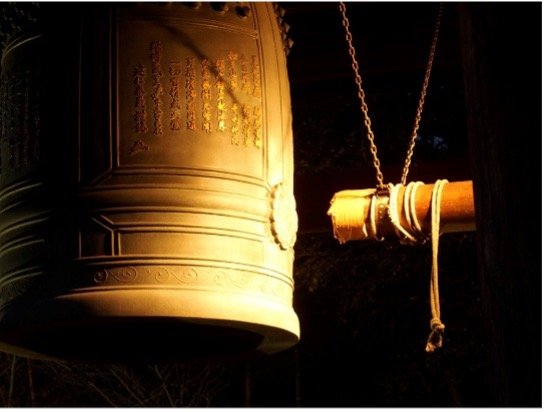
As the year comes to an end, OCBC holds a New Year’s Eve bell-ringing ceremony called Joya-no-Kane (除夜の鐘) on Thursday, December 31 at 4:30PM. As the temple bell rings through the winter night, people gather to reflect on the year that has passed and welcome the year to come.
Traditionally, the bell is rung 108 times, symbolizing the 108 bonno (煩悩), or “blind passions,” that influence our hearts and minds. One traditional explanation connects this number to our six senses—eyes, ears, nose, tongue, body, and mind—and the various experiences and feelings that arise through them. Other explanations also exist, but the central message is that we human beings are deeply influenced by desires, attachments, anger, jealousy, and self-centered thinking. As we listen to the 108 rings, we might wonder: Can we leave our blind passions behind with the passing year? Can we enter the new year with a completely pure heart? From the perspective of Jodo Shinshu Buddhism, these questions lead us to an important teaching of Shinran (1173–1263).
Recognizing Our Blind Passions
In Jodo Shinshu, bonno is often translated as “blind passions.” These are not simply bad habits we can eliminate through willpower. They reflect our limited awareness of how deeply our attachments and self-centered perspectives influence our lives. We may sincerely wish to be kind and patient, yet speak harshly to someone we love. We may want to be generous, yet find ourselves comparing our lives with others. Even when we do something good, we may secretly hope for recognition or appreciation.
Shinran understood that we are bombu (凡夫), ordinary and foolish beings whose lives remain deeply influenced by blind passions. We wish to do good, but we cannot always act as we wish. We may understand what is right, yet struggle to live accordingly. Recognizing this reality does not mean giving up on becoming kinder or taking responsibility for our actions. Rather, it invites us to look honestly at ourselves, acknowledge our limitations, and become more aware of how our actions affect others.
Why Amida Buddha Embraces Us
Here we encounter the profound compassion of Amida Buddha. In Jodo Shinshu, liberation does not depend on our ability to eliminate every blind passion or make ourselves spiritually perfect. If our liberation depended entirely on our own efforts, who among us could ever attain it?
In the Tannisho, Shinran expresses his deep awareness of human limitations: “I am such a person that I do not know what good is, so I am unable to do it, and I do not know what evil is, so I cannot stop doing it.”
This is not an excuse for harmful behavior. It is an expression of profound self-reflection: even when we recognize what is right, our ability to act accordingly remains limited.
Amida Buddha’s Primal Vow arises from boundless wisdom and compassion for beings just like us. Amida does not wait for us to become perfect before embracing us. The Primal Vow reaches us as we are, offering the assurance of liberation through Other Power (tariki).
As we hear and entrust ourselves to the Primal Vow, our blind passions do not simply disappear. Instead, our relationship with them can be transformed. We become more aware of our self-centeredness and limitations, while discovering a deeper sense of humility, gratitude, and compassion for others. The nembutsu, Namo Amida Butsu, is not a declaration of our spiritual achievement. It is an expression of gratitude for the compassion that embraces us just as we are.
Entering the New Year with Gratitude
When we hear the 108 rings of Joya-no-Kane, we do not need to imagine that each sound removes one blind passion from our hearts. Instead, we can receive each sound as an opportunity to reflect on the year we have lived.
Whom have I hurt, knowingly or unknowingly? What am I still holding on to? Where have I failed to understand another person? What kindness have I received that I have taken for granted?
These reflections may not provide comfortable answers. Yet, in the light of Amida’s wisdom and compassion, we can face ourselves without despair. We can acknowledge our limitations while continuing to learn, apologize, reconcile, and care for one another.
The year-end bell reminds us that time passes and our lives are impermanent. We cannot return to yesterday or control everything that tomorrow will bring. But we can enter the coming year with a deeper appreciation for the life we have been given and the people whose lives are intertwined with ours.
In Jodo Shinshu, the question is not how many blind passions we have eliminated, but whether we are hearing the compassionate call of Amida Buddha in the midst of our daily lives.
As we listen to the final bell and welcome the new year, may we hear its rings together with the nembutsu: Namo Amida Butsu.
May we live with gratitude for the compassion that embraces us, humility in recognizing our limitations, and kindness toward all those who share this journey with us. We enter the new year not because we have overcome all our blind passions, but because even as ordinary beings burdened with blind passions, we are embraced by the boundless compassion of Amida Buddha.
I wish everyone a Happy New Year 2027!
Namo Amidabutsu
Rev. Dr. Mutsumi Wondra
