Bodhi Day
Donald S. Lopez Jr. - Tricycle Magazine
“The most important moment in the history of Buddhism, the cosmic moment, the salvific moment, occurs at night, in silence, and in solitude.”
“Nothing is spoken; nothing is heard. Like Moses on the mountain top and Muhammad in the cave, the prince, in his solitude, is unwitnessed by human eyes. But unlike them, he receives no command to recite, no commandments carved on tablets of stone.”
“There is no God, or his messenger, there is no witness. And there is no drama, no burning bush, no empty tomb. There is simply a man sitting cross-legged under a tree in a forest as a new day dawns.”
“What he has experienced had not been preserved to be uncovered; it had not been hidden to be revealed. The enlightenment of the Buddha is said to be the same enlightenment achieved by the buddhas of the past, a truth that had been forgotten.” — Donald S. Lopez Jr.
He was literally all alone in the wilderness, both physically and spiritually. It was here that he sat. He would not get up until he found a Middle Way. A path between a world of paired opposites. It is on December 8, facing East, towards the morning star, that the Prince became a Buddha. It is not another title but instead it is an adjective. To be "Buddha" is to be "Awake."
He then sits for an additional seven weeks, enjoying life through new eyes. But then he begins to feel an obligation to share the Buddhist Path with others. The Buddha would put his experience into words in hopes that others might hear the Dharma and practice The Way as he had done. He teaches for 45 years. Many did not appreciate his insights but he continued to teach because he knew that all beings have the potential for awakening. It is this ability to teach effectively and his use of poetic language that can be considered the beginning of Pure Land Buddhism.
The Buddha teaches to both mendicants and householders, tailoring his message to his audience. He reaches people where they are in their lives. He also gives practices that enable them to change their perspectives and orientations without having to change who they actually are. The Buddha also relies on the same mechanism that create bad habits to effect positive change within us: listening, speaking and awareness. But ultimately, we are our own masters and it is our responsibility to choose how we wish to live our lives. Either chasing extremes or finding a place where we can relax and exhale.
In this way, for over 2,500 years, the student becomes the teacher. As one practices, others begin to follow. For 45 years, the Buddha practiced. It was his devout studentship that created what we now call Buddhism. He was on a path that others followed. Not as a divine being or a god but as someone to emulate. To this very day, this is the goal of all Buddhists.
This story is highlighted in a short clip from the PBS documentary The Buddha (2010), narrated by the actor and Tibetan Buddhist Richard Gere. To view, please follow this link: Awakening Siddharta - PBS.
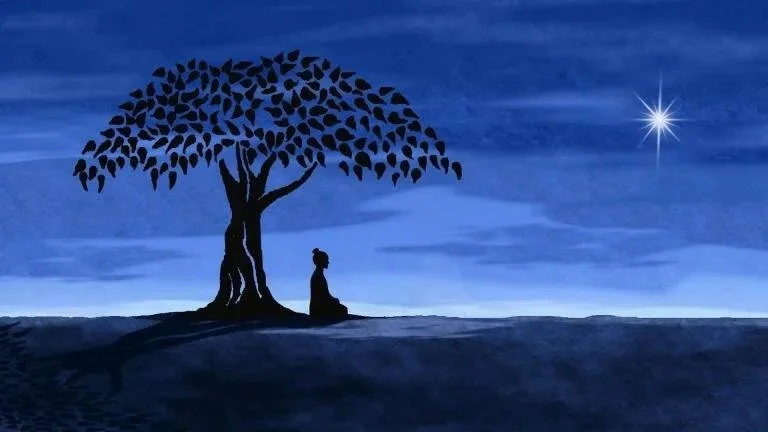
PBS - The Buddha (2010)
I hope that we can all take the time to reflect on what a Bodhi Day would mean within our own lives. What a wonderful New Year’s resolution this would be, to reorient our lives towards practice and follow the Way. This is how we can all have a truly happy New Year for both ourselves and for those all around us.
The Buddha was able to celebrate every year of his life in this way from 35 until 80 years of age when he passed away under the twin sala trees facing West. His life came to an end just like it will for all of us, but this was a life of great meaning; nothing had been left undone.
Namuamidabutsu, Rev. Jon Turner
